

Sep
The concept of yajna is a profound idea central to Vedic tradition. The word yajna is from a Sanskrit root called yaj, which means sacrifice but also to worship, honor, unite, and offer, without expecting anything in return. It is an act of service and offering through love and delight that frees mind, body, and spirit and creates no further karma because dharma is fulfilled. In the Bhagavad Gita, this kind of service or offering is called nishkama karma. Every true act of yajna contains these elements.
The early seers and teachers saw the entire universe as a constant ritual of sacrifice. Although it is often translated as sacrifice, the English word only hints at its true meaning. In the Vedas, yajna is not just a fire ritual where we offer substances into the sacred fire; it is the principle by which the universe is sustained. It is the eternal cycle of giving, receiving, and transformation.
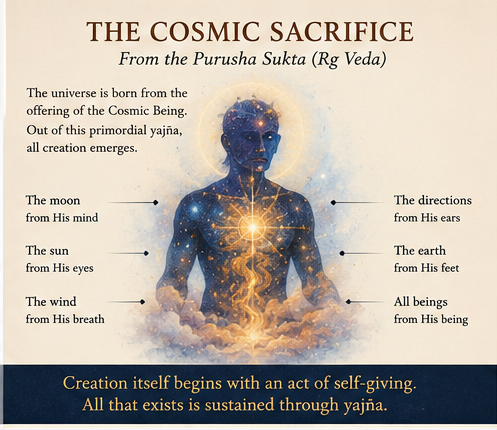
The universe is an expression of one great yajna. When human beings live in accordance to this same principle of yajna, then harmony arises. When we take without giving back, imbalance follows. Perhaps the greatest expression of yajna appears in the Purusha Suktam of Rig Veda. Here, the Cosmic Being Purusha, who is transcendent beyond form, offers itself so that all universes may come into existence in their physical form, including our own. The One, Purusha, becomes the many, which is creation. Creation itself begins with the act of self-giving without expecting anything in return. It is just an act of joy.
From the ocean of consciousness, grace (Purusha) descended to Earth. We are all drops from that ocean of consciousness and are infused with the energy of the beyond or “before” or what we call God. The magic is to remember that we are a sliver of Purusha. We have inherited this, all that we are, from the unseen being which became seen through us, the universe, and everything that lives within this universe.
The question to ask is are we human beings having a divine experience or divine beings having a human experience? The answer is we are lucky with the gift of life to experience both. Keep your eye on the bigger picture because the truth, sometimes called “secret knowledge,” is shrouded in mystery and is revealed when you are ready to receive it, which means we, as humans have to be open, willing, and ready to receive the truth with grace.
The universe emanated from an organized divine order, an unseen infinite reality or Oneness. Spirit, the divine intelligence of power, beauty and unconditional love descended and became matter which is our Earth, us, and this physical universe as we know it. Spirit and matter are two sides of the same coin. One does not exist without the other. In other words, the unseen spirit organize itself as matter into the five elements—ether, air, fire, water and earth. We are a reflection of this spirit, much like the moon gets its light from the sun, and we are considered the spark of that divine.
There are two orbs in the sky—the sun and the moon. The sun has its own light. The moon has no light—it borrows it from the sun. Where does the light of the sun come from? It is powered by some unseen force. We have inherited the spark of that unseen force which we call god, source, creator, or Purusha. There are many words for it. The unseen force (Purusha) becomes us, the universe, and every living thing in it as we experience it.
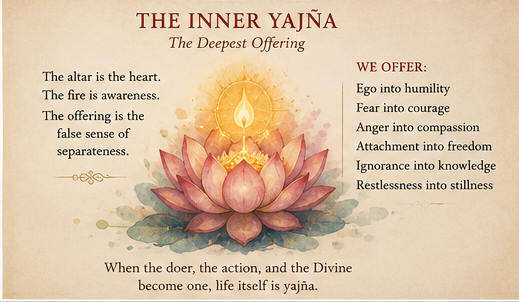
Yajna is symbolic of our life journey, and fire, agni, is the central theme of the journey. Yajna is a means to connect to the spiritual energies within us. Human transformation happens in earthly life by exercising free will to navigate our karma through righteous action, which is dharma, to do the right thing. Righteous action surrenders and releases our ingrained habitual patterns of selfishness, which derives from ego. We offer these patterns into the fire altar, either by physically writing them down on a piece of paper and putting them in the fire to burn or by making a mental intention (sankalpa) to surrender and release them. The habitual patterns become the offering, and compassionate action becomes the fragrance that remains. Ego becomes humility. Fear transforms into courage, anger into compassion, attachment into freedom, and restlessness into stillness.
So the question that arises is, why did this Cosmic Being create the universe? My simple answer to that is because it could and it wanted to experience itself. Through a prayerful offering, it created this universe out of pure joy and delight and at the same time, allowed us and all living things to collaborate, cohabitate, co-participate and be part of this delight if we choose to. The part that the Cosmic Being Purusha sacrificed to bring the universe into existence is only a fraction of the potency of this Cosmic Being, or the absolute. Purusha offered only a fraction of its potency because our limited human senses would not be able to receive all of what it is capable of.
When you think about yajna, visualize someone doing a fire ceremony, which includes the representation of the five elements with ghee, flowers, fruit, seeds, etc. These representations of the five elements are offered into the fire. In every Vedic yajna, the sacred fire is central. Fire transforms. It takes something material and returns it to the invisible. Butter becomes light. Wood becomes heat. Grains become fragrant. The visible becomes subtle. But yajna is so much more than a physical fire ceremony as I referred to above, where we offer our habitual patterns (vasanas) to the fire to discover the pure self within.
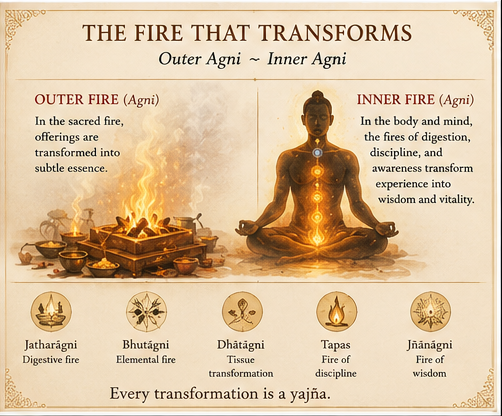
The outer fire mirrors an inner fire, and both are called agni. In Ayurveda, agni is the digestive fire that transforms food into energy, tissues, vitality, and consciousness when your agni is in balance. When agni is balanced, digestion, vitality, clarity, immunity, and tissue formation are supported, and hence, we feel radiant and happy.
Yoga speaks of the fire of tapas, which transforms heat into wisdom. Tapas is Sanskrit for “heat” in terms of both the actual heat generated by your body during the practice of yoga and the inner fire, which is the self-control and discipline that burns impurities and purifies the mind to clear energetic blocks and habits that keep us from achieving personal growth. Meditation and breath becomes the fire that consumes distraction and reveals clarity.
Hence, agni straddles the human and divine realms. In Vedic thought, agni is present on Earth yet belongs amongst the gods. Humans feed the agni with ghee, grains, wood, and sacred utterances which are mantras. Agni receives these offerings and carries them beyond the visible world in the form of smoke to the heavens, and in return, we receive blessings. This is what I call a consecrated exchange between the two realms. Agni is therefore the divine messenger and mediator that makes communication between the divine and profane realms possible.
Thus, every authentic transformation is yajna. The word “sacred” comes from “sacrifice.”
When we offer our time to someone in need…
When parents stay awake through the night caring for a child…
When a teacher dedicates years to preserving wisdom…
When an artist spends thousands of hours perfecting a craft…
These are acts of yajna.
With focused concentration (dhyana), intense will (iccha), and total devotion (shraddha), everything is transformed through sacrifice into harmony and peace.
This is an act of prayer and giving.
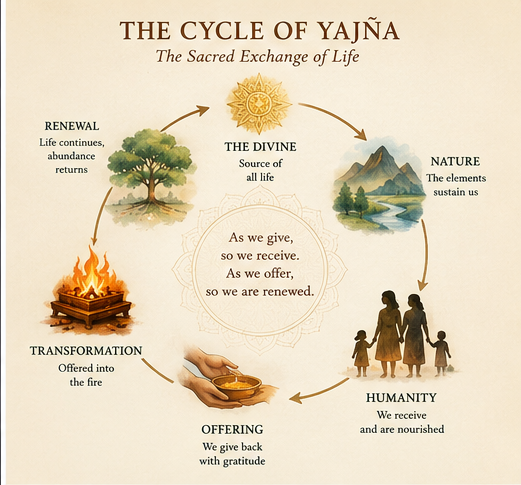
The cycle of yajna is the sacred exchange of life. It begins with the source, the divine, which brings forth nature and the elements that sustain us (earth, water, fire, air, and ether). Humans are then nourished by the elements. When humans give offerings with pure gratitude and devotion without expecting anything in return, this brings about transformation. As we give, so we receive. As we offer, so we are renewed.
Living Yajna Today
How can the practice of yajna translate into daily life? When done with reverence and without self-interest, every action becomes sacred. Prepare your food with love. Listen to others deeply with full attention. Be kind to and care for animals, plants, and all living beings. Share knowledge. Serve without expectation.
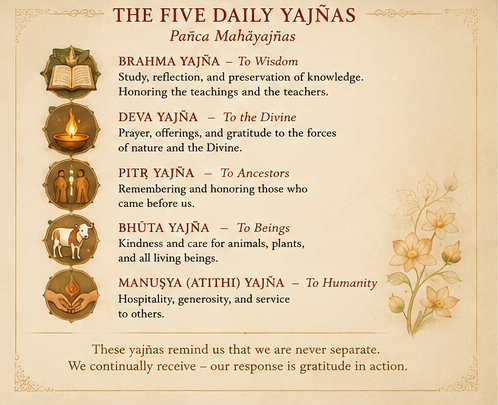
Yajna therefore represents existence itself as an exchange. Nothing lives entirely for itself. Food becomes body. Fuel becomes flame. Intention becomes action. And offering becomes a blessing. This brings about the transformation of our divine latent energies. Ultimately, our goal is to allow the flow of cosmic energies so that we may reach the divine and live in harmony with the cosmic order.
When I sit with the Purusha suktam, the hymn that I learned, I feel I am touching an ancient seam in the fabric of the universe, a quiet pulse where the one becomes the many, where consciousness exhales itself into form.
This is not just a cosmology.
It is an invitation to recognize
The life you live in continuation of that ancient yajna—
Every breath is a sacred exchange
Every action a quiet offering
Every moment a chance
To return to the truth
That you are made of the very substance of the divine.